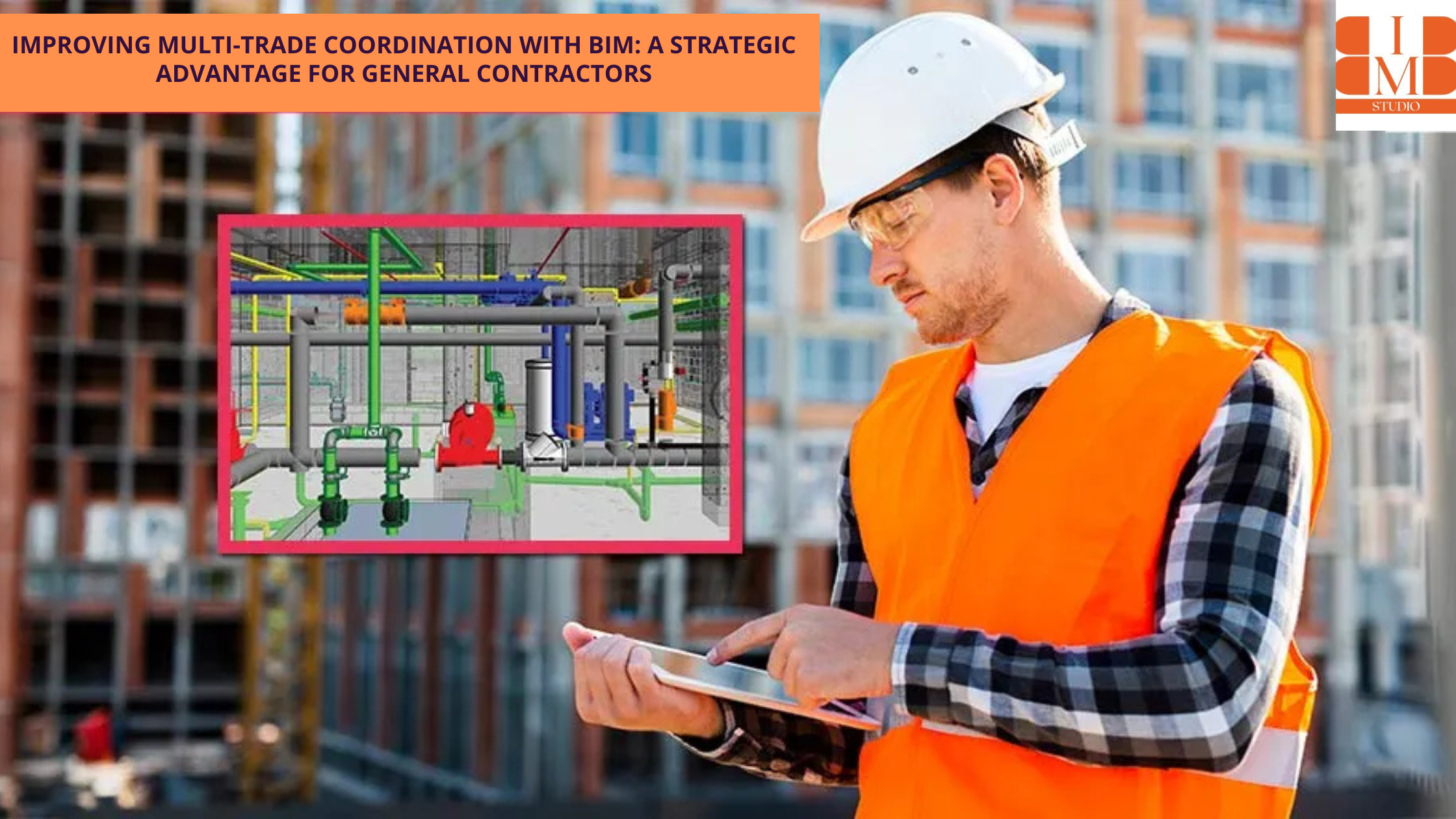
If you’re managing construction projects today, you know one hard truth: Coordination can make or break a project. When architects, structural engineers, MEP teams, and contractors don’t align early, small errors quickly turn into massive delays, costly rework, and frustrated clients.
And here’s the catch: traditional methods of coordination simply can’t keep pace with the complexity of today’s buildings.
Because BIM isn’t just a 3D model; rather, it is an intelligent, data-rich platform that establishes Multi Trade Coordination right from the initial design sketch up to the very final handover. Combined with the best BIM software, it creates one shared environment where every discipline works in sync instead of working in silos.
With BIM, the digital twin of the entire project can be constructed to simulate, analyze, and coordinate virtually everything before the first brick is laid. And with accurate LOD BIM modeling, every trade gets precisely the level of detail they need at each stage.
You do know and I know:
General contractors don’t just build structures; they manage people, systems, risks, and timelines.
So, improvement in coordination is not an option any longer. It’s a competitive edge. In this blog, I will walk through the challenges of trade coordination step by step and show how BIM brings clarity, control, and consistency throughout the whole project life cycle.
Trade Coordination Challenges across Project Stages
Every construction project goes through several stages. Each of these leads to a greater risk in poor Coordination of the teams if they do not work in sync. Architects, structural engineers, the MEP trades, fabricators, and contractors all produce critical information, but unless that information aligns, the entire project suffers. Understanding the various challenges in Multi-Trade Coordination across all the project stages is therefore essential, particularly before the adoption of BIM workflows or the selection of the Best BIM Software.
Different disciplines work in silos.
Each trade focuses on its design or model without understanding how their work impacts . Major coordination gaps arise in this regard as the project progresses. When teams work independently, errors are kept hidden until the final stages when they are more difficult and costly to resolve.
Inconsistent levels of detail across models
Architectural, structural, and MEP models are created in different LOD BIM standards; when the LOD does not match from one discipline to another, elements do not fit together during coordination, leading to clashes, misalignment, and confusion about which information is accurate.
Frequent design changes are not being communicated properly.
On most projects, design updates occur with regularity, but not all trades receive the update at the same time. Out-of-date drawings or an old model create a conflict in versions. Therefore, coordination sessions become slow since teams need to recheck everything.
Lack of a Centralized Digital Platform
While e-mailing files, utilizing offline folders, or storing them in disparate locations, it remains unknown for the teams which model version is current. Without a proper Common Data Environment or digital twin construction workflow, information becomes inconsistent and unreliable.
Clash Detection and Issue Resolution – Delayed
Conflicts will always occur, but when clash detection occurs too late in the process, project-wide delays become inevitable. The longer clashes go unresolved, the more far-reaching the impacts will be on shop drawings, procurement timelines, and construction sequencing.
Poor communication among project stakeholders
Different trades use different tools, standards, and workflows, which results in slow decision-making, repeated discussions on the same problem. Communication breaks down quickly without structured BIM coordination meetings.
Design Stage
It is during this design stage that every discipline starts to shape the project, but this is also where most of the Coordination problems start. Without structured workflows and Best BIM Software, design teams often work with assumptions instead of real-time data. Hence, Multi Trade Coordination becomes difficult even before modeling is complete.
Design Teams Follow Different Priorities
Architects design spaces, structural teams are concerned with stability, and MEP designers route critical building systems. Without an integrated Coordination effort from the outset, each discipline advances its own needs, and this misalignment in the design becomes progressively more difficult to resolve as the project advances.
Frequent design changes disrupt the workflow.
Architectural revisions are constant at this stage. But when changes aren’t shared in real-time, other trades continue working on outdated layouts. The lack of synced updates thus directly affects Multi Trade Coordination and increases the number of clashes further downstream.
Uneven Use of LOD Standards Across Disciplines
Some teams model at LOD 200, while others jump ahead to LOD 300 or 350. This mismatch affects the way that model elements align and interact. The Best BIM Software can standardize LOD BIM expectations; without that, the trades have a difficult time understanding what is final and what is conceptual.
No Centralized Model for Early Collaboration
Many design teams continue to work in separate modeling environments instead of from within a single BIM platform. Without a single shared model, Coordination is slow and fragmented. This leads to repeated questions, duplicated work, and lost information between disciplines.
Early clashes go unnoticed without BIM tools.
Where clash detection isn’t introduced at the design stage, issues stay hidden until pre-construction. This results in a backlog of problems that could have been resolved easily much earlier. The use of Best BIM Software for early checks for clashes ensures Multi Trade Coordination gets off on solid ground.
Pre-Construction Stage
The pre-construction stage is where Coordination becomes critical because this is the point at which design intentions must translate into practical construction plans. As the trades begin to develop their detailed models, create schedules, estimate quantities, and prepare shop drawings, every decision depends on the accuracy of the information shared. Without the Best BIM Software to centralize updates, the pre-construction phase often gets overloaded with conflicts, miscommunication, and delays that could have been prevented by stronger Multi Trade Coordination right from the beginning.
At this stage, one of the biggest challenges is the gap between the design intent and actual constructability. Even if the design team has worked out with utmost care, the moment MEP, fire protection, plumbing, and low-voltage systems begin to model in detail, spatial issues show up. Issues show up because systems must compete for the same vertical and horizontal space. Where disciplined Coordination is lacking, ducts clash with beams, pipes cut through walls, and equipment rooms fail to meet access requirements. This is precisely where BIM proves its value: Teams can review models together and resolve conflicts before construction ever begins, saving unnecessary time and material.
Another major problem at the pre-construction stage is inconsistency in versions. Trades get updated architectural or structural files at different times. When updates are not synchronized, each trade works on a different version of the project. So, the coordination environment is full of outdated information, duplicated work, and avoidable mistakes. A Common Data Environment with a single source of truth takes away the confusion and is created on the support of Best BIM Software. With each trade accessing the same model at the same time, Coordination becomes much faster and more reliable.
Pre-construction coordination also greatly influences cost planning and scheduling. As trades begin to detail their models, quantities become more accurate, and sequencing becomes better understood. However, when the underlying model contains unresolved clashes or inconsistent LOD standards in the BIM, then cost estimates cannot be accurately made, and construction timelines cannot be predicted. This leads to misunderstandings with clients, budget revisions, and delays in procurement. Strong Multi Trade Coordination during this time ensures that cost and schedule planning is based upon verified, clash-free information-not assumptions. Finally, it’s in pre-construction that digital simulations really start to play a big role. With 4D sequencing, constructability analysis, and digital twin workflows, teams can visually plan the entire project long before construction starts. But of course, these simulations are only useful when the model is coordinated-if there are unresolved conflicts or mismatched details in the model, the simulation becomes misleading rather than helpful. Using BIM right at this stage means digital twin construction methods provide accurate insights to allow the general contractor to make decisions with confidence.
Handover & Facility Management Stage
The handover and facility management stage is where everything finally comes together, and ironically, it’s also where every gap in coordination becomes impossible to hide. Up until this point, teams can still resolve clashes, revise drawings, or update schedules. But once you reach handover, there’s no going back-owners need accurate data, and the building has to perform from day one. That’s why general contractors who prioritize multi-trade coordination throughout the project end up delivering a smoother and more predictable turnover process. When every trade shares aligned information and works from the same structured model, the final package is not just complete-it’s dependable, organized, and immediately usable for facility managers.
But here’s where it gets even more critical.
Think of a facility manager receiving inconsistent PDFs, outdated drawings, missing equipment details, and incomplete O&M manuals. This is still shockingly common in projects that ignore coordination standards early on. And the result? Delayed maintenance, operational confusion, extended downtime, and frustrated building owners. It is for this reason that leading contractors use the Best BIM Software to standardize the whole documentation workflow. Rather than dumping a stack of files on the owner, they deliver a structured, highly detailed BIM model supported by accurate asset data, location details, maintenance parameters, and verified specifications.
Now, let’s raise the bar.
Because today, facility teams don’t just want a model; they want a living system. And that is where digital twin construction becomes a game changer. Unlike traditional handover documents, a digital twin acts as a real-time operational model, tracking performance, predicting failures, enhancing maintenance planning, and smoothing out asset management. But here’s the catch: you get a reliable digital twin only when a project has strong multi-trade coordination and follows clear LOD BIM standards. Every component, from HVAC equipment to fire sprinklers, must be modeled to the right LOD level so that the facility team receives data that is accurate, traceable, and ready for use in their FM systems.
Let’s dig deeper…
When contractors follow agreed-upon, consistent BIM protocols, the final handover often becomes almost effortless. On day one, facility managers can instantly find equipment, check the maintenance cycles, review installation history, and plan upgrades without digging through conflicting documents. The building starts operating smoothly immediately since every system-mechanical, electrical, plumbing, structural-is well documented and aligned within the model. This leads to long-term stability with reduced operational costs for the owner and proves the real value in early and continuous coordination. In other words, the handover & FM is not simply the end of construction; rather, it is the start of the life of the building. And how good that life will be entirely depends upon how strong your multi-trade coordination is, the accuracy of your LOD BIM, and how powerful the Best BIM Software is to carry the information from design to operations. When these three work together, your digital twin becomes not just a model but a long-term asset that changes how the facility is managed for decades.
Conclusion
It’s ultimately the coordination that makes the difference in smooth, predictable projects versus those filled with delays and rework. When general contractors use the best BIM software, they create a workflow in which every trade stays connected, every decision is transparent, and every model supports accurate planning. This level of multi-trade coordination reduces clashes, improves communication, and sets the entire project up for success.
And here is the real advantage…
Notably, with the rise of digital twin construction and standardized LOD BIM processes, buildings are no longer handed over as static structures; instead, they become intelligent assets that help in long-term facility management. This future-ready approach only works when coordination is strong from the very start.
So the message is straightforward: the better your coordination, the stronger the project outcome. Contractors who embrace BIM-driven collaboration deliver higher-quality results, faster timelines, and smarter buildings-making coordination not just a process but a strategic advantage.
FAQs
What is multi-trade coordination in construction?
It is the process of aligning architectural, structural, and MEP trades so their designs fit together without clashes, thus improving general project coordination.
Why is coordination important for contractors?
Strong coordination minimizes delays, prevents rework, and enables the construction activities to run smoothly right from the start.
How does BIM support coordination?
BIM offers a common digital model that allows all trades to detect clashes early, review layouts, and work with accurate information.
Which is the best BIM software for coordination?
Tools such as Revit, Navisworks, and BIM 360 are widely employed since they enhance clash detection as well as team collaboration.
How does digital twin construction help after handover?
This will provide facility managers with a real-time virtual model of the building, enhancing maintenance, planning, and long-term management.