How Scan to BIM Services Add Value in Construction
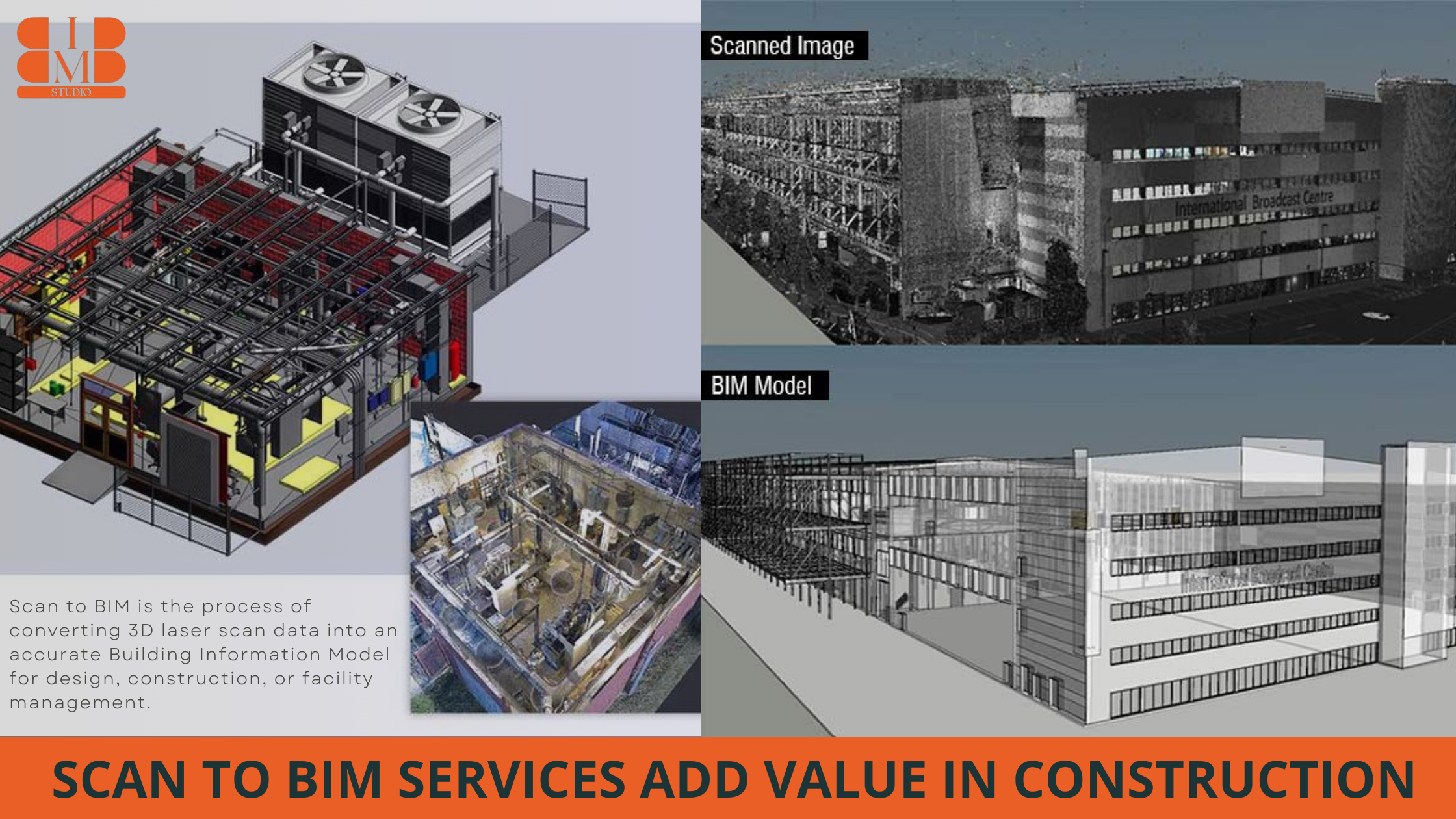
In today’s high-speed construction world, Scan to BIM has become a revolutionary process that brings the physical and digital worlds together. Using sophisticated 3D laser scanning, drones, or LiDAR technology, it records minute spatial information of a building or site and converts it into an intelligent Building Information Model (BIM). This model is a precise computer equivalent to current conditions, allowing project teams to make informed decisions right from the start. The use of Scan to BIM services is no longer just for massive projects—it’s now becoming the standard practice in all renovations, retrofits, infrastructure improvements, and green building construction. When this process is integrated with top-of-the-line BIM software, construction professionals can optimize workflows, identify clashes earlier, and even improve environmental performance according to BIM for sustainable construction objectives. Whether for engineers, contractors, or architects, Scan to BIM Services guarantees that all measurements, angles, and material specifications are accurately captured for less rework and easier project delivery. What is Scan to BIM? Scan to BIM is the process of digitizing a physical environment—such as a historic building, roadways, or a construction site—with high-end 3D laser scanning or LiDAR technology, and then translating that information into a comprehensive Building Information Model (BIM). Not only is this model a visual representation, it’s a rich data digital resource filled with accurate measurements, geometry, and metadata on every discernible feature. The process begins with point cloud capture, where millions of points scan the surfaces of walls, floors, ceilings, MEP components, and structural elements. Those points are then imported into a BIM program like Autodesk Revit, where they are converted to an accurate 3D model. That one model is used for several purposes—design verification, renovation planning, clash detection, facility management, and even sustainability analysis. By using Scan to BIM services, construction teams eliminate the guesswork involved in previous 2D drawings or manual measurements. Rather, they are working with a “single source of truth” that accurately represents the actual conditions of the site, resulting in more streamlined planning, lower costs, and shorter project timelines. How Scan to BIM Works Scan to BIM is a standardized process of converting real-world building information into a smart 3D model. This can subsequently be employed for planning, refurbishment, facility management, and even green construction work. Here’s a step-by-step overview: 1. Site Data Capture It starts with surveying on site with the help of high-precision 3D laser scanners or LiDAR equipment. The building or site is scanned from several directions using these devices, with each device taking millions of points per second. It produces a point cloud — a minutely detailed digital image of the current space. This is an important step because how well the scan is done will directly affect the accuracy of the BIM model. 2. Data Registration and Processing Once raw scan data is obtained, it is processed with sophisticated point cloud processing software. At this phase: Multiple scans are registered to form an overall view of the site. Noise or unnecessary data is eliminated to enhance readability. The registered point cloud is the basis for modeling. 3. Import into BIM Software The processed point cloud is then transferred into top BIM software like Autodesk Revit, ArchiCAD, or Bentley Systems. These programs enable BIM experts to engage with the point cloud and initiate the process of modeling. 4. Intelligent Model Creation With the use of the imported scan, experienced BIM technicians sketch and design smart 3D objects — walls, floors, windows, structural members, MEP systems, and architectural elements. Unlike simple 3D models, a BIM model holds full data, including material specifications, dimensions, and maintenance information. 5. Quality Control and Accuracy Verification Before the model is finally delivered, the model is thoroughly checked for quality to ensure that it is dimensionally correct and also conforms to the actual site conditions. Discrepancies are adjusted at this point to make the model dependable for use in construction or renovation activities. 6. Delivery and Integration The final BIM model is handed over to the client in a format of choice, prepared for usage in project planning, clash detection, cost estimation, or sustainable construction analysis. By adopting this organized workflow, Scan to BIM services are able to guarantee the establishment of a correct, data-enriched model as a single source of information for architects, engineers, and builders. Creating and Using the Model After the Scan to BIM process takes precise 3D point cloud measurements, the second most important step is converting this raw scan into a working BIM model. This is where the true benefit of Scan to BIM services comes in — converting complicated measurements into smart, structured data that architects, engineers, and contractors can readily utilize. 1. Converting Point Cloud to BIM Model Point cloud data from laser scanners or LiDAR is imported into the best BIM software like Autodesk Revit or ArchiCAD. Here, trained modelers build accurate 3D geometry of building components — walls, floors, ceilings, MEP systems, and structural elements. It is not merely a visual image; each element holds extensive metadata such as dimensions, materials, and asset specs. 2. Defining Levels of Detail (LOD) Depending on the project objective, the BIM model can be created at various Levels of Detail (LOD), from conceptual LOD 200 to highly detailed LOD 500 utilized for facility operations. For instance: LOD 300 for design coordination LOD 400 for construction and manufacturing LOD 500 for as-built records and operations 3. Integrating with Project Workflows After the BIM model is prepared, it can be integrated into different stages of construction: Design Coordination: Identify clashes among architectural, structural, and MEP systems prior to construction. Renovation Planning: Utilize the as-built model to stage modifications with the least amount of disruption. Sustainable Construction: Integrate with energy analysis software to maximize building performance and sustainability. 4. Ongoing Usage and Maintenance Scan to BIM is not a one-time use tool. It is a living document that can be modified as the building matures. It is something that facility managers can count on for operations, asset management, and even … Read more